
What is the Metaverse?
What is a Metaverse exactly? How does one define the term, and where does one draw a line between a Metaverse and, say, just another virtual world? These are common questions that people ask about the Metaverse development context. In many ways, the Metaverse represents the next evolution of the internet. Encompassing social interactions, immersive experiences, and advanced economic systems. Discover the ongoing advancements and key aspects shaping the Metaverse’s development and its potential impact on the future of digital interactions and economies.
The Metaverse refers to an online virtual world, where individuals experience a variety of interactions, environments, and objects. Mainly through 3D digital avatars, users engage in real time communication and coupled in an immersive experience.
Two competing visions for the Metaverse exist right now: One envisions it as decentralized, generous with property rights and new frontiers, interoperable, open, and owned by the communities that build and maintain it. The other vision, which is too familiar to many people today, portrays it as centralized, closed, subject to the whims of corporations, and often extracting painful economic rents from its creators, contributors, and inhabitants.
The key dimension to compare these two visions is openness versus closure. And we can conceptualize the differences between them as follows:
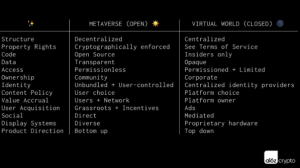
An open Metaverse is decentralized, allows users to control identity, enforces property rights, aligns incentives. And ensures value accrues to users (not platforms). An open Metaverse is also transparent, permissionless, interoperable, and composable (others can freely build within and across Metaverses), among other criteria.
Essential ingredients of a Metaverse
Achieving a “true” Metaverse — one that’s open versus closed — requires seven essential ingredients intrinsic to this sought-after state. We argue that these are necessary to meet the minimum requirement to be called a Metaverse.
1. Decentralization
Centralized platforms tend to start friendly and cooperative to attract users and developers, but once growth slows they become competitive, extractive, and zero-sum in their relationships. Often these powerful intermediaries engage in user rights abuses and de-platforming, and they host captive economies with aggressive take-rates. Decentralized systems, on the other hand, exhibit more equitable ownership among stakeholders. And reduced censorship, and greater diversity. dissuades people from building on top, hampering innovation. Because centralized platforms cannot make the same kinds of strong commitments — controlled by code — that blockchains can, their promises can be revoked or altered whenever an arrangement no longer makes sense to the whims of leaders or organizations.
2. Property rights
Most successful video games today make money by selling in-game items, like “skins”, “emotes”, and other digital goods. But people who currently buy in-game items aren’t actually buying items – they’re renting them.
As soon as anyone leaves for a different game — or the game in question unilaterally decides to shut down or switch up the rules — players lose access. People have grown so accustomed to renting from the centralized services of web2 that the idea of actually owning things — digital objects you can sell, trade, or take elsewhere — often strikes people as odd.
But the digital world ought to obey the same logic as the physical world: when you buy something, you own it. It’s yours. Just as courts of law uphold these rights in the physical world, so should code enforce it online. It just so happens that true digital property rights weren’t possible before the advent of cryptography, blockchain technology, and related innovations such as NFTs. Put simply, metaverses turn digital serfs into homesteaders.
3. Self-sovereign identity
Identity is closely related to property rights. You can’t own anything if you don’t own yourself. As in the real world, people’s identities must be able to persist throughout the metaverse without complete reliance on a small set of centralized identity providers.
Authentication is about identity: proving who a person is, what they have access to, and what information they share. On the web today, this requires asking an intermediary to do so on one’s behalf with popular one-click login methods like social login or single sign-on (SSO). Today’s biggest tech platforms, like Meta and Google. Use this approach to collect data to build their businesses: monitoring people’s behavior to develop models that serve more relevant ads. In addition, because these platforms have complete control, trying to innovate on the authentication process relies on the honesty and willingness of the corporation behind the platform.
The cryptography at the core of web3 enables people to authenticate without relying on these intermediaries, so people can control their identity directly or with the help of services they choose. Wallets (like Metamask and Phantom) provide ways for people to verify themselves. Standards like EIP-4361 (Sign-in with Ethereum) and ENS (Ethereum Name Service) allow projects to coordinate around open source protocols and contribute independently to a richer, more secure, and continually evolving concept of digital identity.
4. Composability
Composability is a systems design principle, and here specifically it’s the ability to mix and match software components like lego bricks. Every software component only needs to be written once, and can thereafter simply be reused. It’s analogous to compounding interest in finance or Moore’s law in computing — some of the most powerful known economic forces — because of the exponential power it can unlock.
To feature composability — a concept closely intertwined with interoperability — a metaverse development context would have to offer high quality, and open, technical standards as a foundation. In games like Minecraft and Roblox, you can build digital goods and new experiences out of the basic components supplied by the system. But it’s harder to move them outside that context or modify their inner workings. Companies offering embeddable services, like Stripe for payments or Twilio for communications, work across websites and apps — but they don’t allow outside developers to change or remix their black boxes of code.
5. Openness/open source
True composability is impossible in the absence of open source, which is the practice of making code freely available and able to be redistributed and modified at will. Regardless of degree or kind, open source as a principle is so essential to the development of a metaverse. That we’ve broken it out as its own separate ingredient despite the overlap with composability above.
So what does open source mean in a metaverse development context? The best programmers and creators — not the platforms — need full control to be fully innovative. Open source, and openness, helps ensure this. When codebases, algorithms, marketplaces. Protocols are transparent public goods, builders can pursue the fullness of their visions. And ambitions to build more sophisticated, trustable experiences.
The power of composability in web3 is largely due to its open source ethos.
6. Community ownership
In a Metaverse development context, all stakeholders should have a say. Proportionally to their involvement, in the governance of the system. People should not just have to abide by the edicts passed down by a group of product managers at a tech company. If any one entity owns or controls this virtual world, then much like Disney World, it may offer a certain form of contained escapism but will never live up to its true potential.
Community ownership is the piece of the puzzle that aligns network participants — builders, creators, investors. And users — to cooperate and strive for a common good. This miracle of coordination — previously unwieldy or not possible without the advent of crypto and blockchains — is orchestrated through the ownership of tokens, the native assets of networks.
Beyond the technological advancements created by decentralization. The philosophical implications of a community-owned space is crucial to the success of the Metaverse. Across web3, participants in decentralized autonomous organizations, or DAOs, have taken this principle to heart. They are eschewing the formal rigidity of corporate structures in favor of more flexible. Also more varied democratic, and informal experiments in governance. Users govern, build, and drive forward communities, rather than being governed, built, and driven forward by a single entity.
Beyond the technological advancements created by decentralization. And the philosophical implications of a community-owned space is crucial to the success of the Metaverse. Across web3, participants in decentralized autonomous organizations, or DAOs, have taken this principle to heart. They are eschewing the formal rigidity of corporate structures in favor of more flexible. Also more varied democratic, and informal experiments in governance. Users govern, build, and drive forward communities, instead of being governed, built, and driven forward by a single entity.
7. Social immersion
Big tech companies would have you believe that high-powered virtual reality . And augmented reality (VR/AR) hardware is an essential — perhaps even the most essential — ingredient in a Metaverse. This is because those devices are a trojan horse. Corporations see them as a way to becoming the dominant computing interface suppliers for 3D virtual worlds. And thereby also becoming the choke points that intermediate people’s Metaverse experiences.
A Metaverse does not have to exist in VR/AR. All that’s necessary for a metaverse development context to exist is social immersion in the broad sense. What’s more important than hardware is the type of activities Metaverses enable. They will let people remotely hang out, work together. Mingle with friends, and have fun, much like they do using Discord, Twitter Spaces, or Clubhouse today.
The development of an ideal multi-dimensional virtual world will come about gradually. Many problems remain to be solved, lest we wind up with some dystopian analogue of the IOI-mediated Oasis in Ready Player One. If builders stick to these axioms, though, that outcome will be less likely. (If you’re such a problem-solver or builder, get in touch with us!)
Starting April 1, 2022, the government began taxing cryptocurrency investment gains. Imposing a steep 30 per cent tax on income from trade in cryptocurrencies. And a 1 per cent TDS levy on every digital transaction.
He has said that the future of the Internet is decentralization. Which means that all the data, whether financial, social, art. Or anything else, will be stored on the blockchain, and that the public, in general, would own it.
In an interview with Wired. Wood said that the current Web 2.0 applications are based on the user’s trust upon the system. It essentially means that the user is trusting the respective application owner to use their data responsibly. But in Web 3.0 blockchain-based apps (Dapps). All the data will be stored on the respective blockchain’s public ledger, which anyone can check. So decentralization of data, data security, blockchain, and user-centric applications are the focus of Web 3.0 of Internet technology.
Says Piyush Gupta, president of Kestone. A data-driven sales and marketing solutions company: “The potential of Web 3 applications like Metaverse .
Blockchain, and so on, are not limited to entertainment only; going forward, people can use them in the fields of education, healthcare, science, etc. And consumers would be the biggest beneficiaries. Much like the Internet today, ‘Meta Surfers’ would be able to experience, learn and consume in an innovative new way.”
- NFT: Non-fungible tokens are nothing but a unique locked token of a particular crypto blockchain’s native token. Any type of data can be stored as an NFT. Including, but not limited to art, music, autograph, movies, house property records, and others. At present, the most popular crypto blockchain for NFTs is Ethereum (ETH), followed by Solana (SOL). The data on NFT is non-fungible, meaning that it cannot be replicated by anyone else. People can view, share, and exchange it, but cannot replicate it.
- Metaverse: This technology enables people to interact with each other and brands using virtual 3D avatars in a virtual animated world. Think of it as a replica of the natural world, but with subtle differences. For instance, Manchester City FC recently unveiled plans to build their Etihad Stadium replica in the Metaverse world. This would allow their fans who couldn’t otherwise go to Manchester to watch a football game live in 3D. In addition, there are numerous brands, fashion labels, and others, who are exploring opportunities in the Metaverse world.
Souces: https://future.a16z.com/7-essential-ingredients-of-a-metaverse/
https://appinventiv.com/blog/web-3-0-blockchain-impact-on-businesses/
Also, Read
Leveraging AI Automation for Personalized Product Recommendations: The Future of E-Commerce
Mind-Reading Martians? No, Just AI Tools Revolutionizing Marketing and Sales!
If Love is in the Air, AI is in the Cloud: Elevating Customer Relationships to New Heights!
